Home › Books › Breaking Bread with the Dead: A Reader's Guide to…
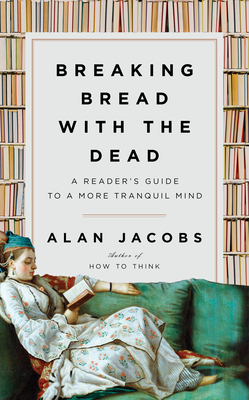
Breaking Bread with the Dead: A Reader's Guide to a More Tranquil Mind
by


20/99
Critics

50/99
Readers
n/a
Scholars
6/99
Rating
34/99
Volume
40/99
Rating
59/99
Volume
—
Sign in to add to your shelf, rate, or review this book.
About This Book
From the author of How to Think and The Pleasures of Reading in an Age of Distraction, a literary guide to engaging with the voices of the past to stay sane in the present W. H. Auden once wrote that "art is our chief means of breaking bread with the dead." In his brilliant and compulsively readable new treatise, Breaking Bread with the Dead, Alan Jacobs shows us that engaging with the strange and wonderful writings of the past might help us live less anxiously in the present—and increase what Thomas Pynchon once called our "personal density." Today we are battling too much information in a society changing at lightning speed, with algorithms aimed at shaping our every thought—plus a sense that history offers no resources, only impediments to overcome or ignore. The modern solution to our problems is to surround ourselves only with what we know and what brings us instant comfort. Jacobs's answer is the opposite: to be in conversation with, and challenged by, those from the past who can tell us what we never thought we needed to know. What can Homer teach us about force? How does Frederick Douglass deal with the massive blind spots of America's Founding Fathers? And what can we learn from modern authors who engage passionately and profoundly with the past? How can Ursula K. Le Guin show us truths about Virgil's female characters that Virgil himself could never have seen? In Breaking Bread with the Dead, a gifted scholar draws us into close and sympathetic engagement with texts from across the ages, including the work of Anita Desai, Henrik Ibsen, Jean Rhys, Simone Weil, Edith Wharton, Amitav Ghosh, Claude Lévi-Strauss, Italo Calvino, and many more. By hearing the voices of the past, we can expand our consciousness, our sympathies, and our wisdom far beyond what our present moment can offer.
Preview
Reviews
"Jacobs, who has taught college-level literature courses for many years, has clearly honed his thoughts in the classroom ..."
"The author steers readers to the enriching wisdom that can be discovered through voices from the past, referencing a broad assortment of writers and philosophers ..."
"Much of what he says here about 'the value of paying attention to old books' will sound supremely reasonable to those who believe it is good to read them, and to read as many of them as possible."
"Jacobs's ideas sometimes feel rehashed rather than enlarged from chapter to chapter, and his language unnecessarily academic ..."
Reader Reviews
0 reviewsSign in to write a review.
No reader reviews yet. Be the first!