Home › Books › Counting: How We Use Numbers to Decide What Matte…
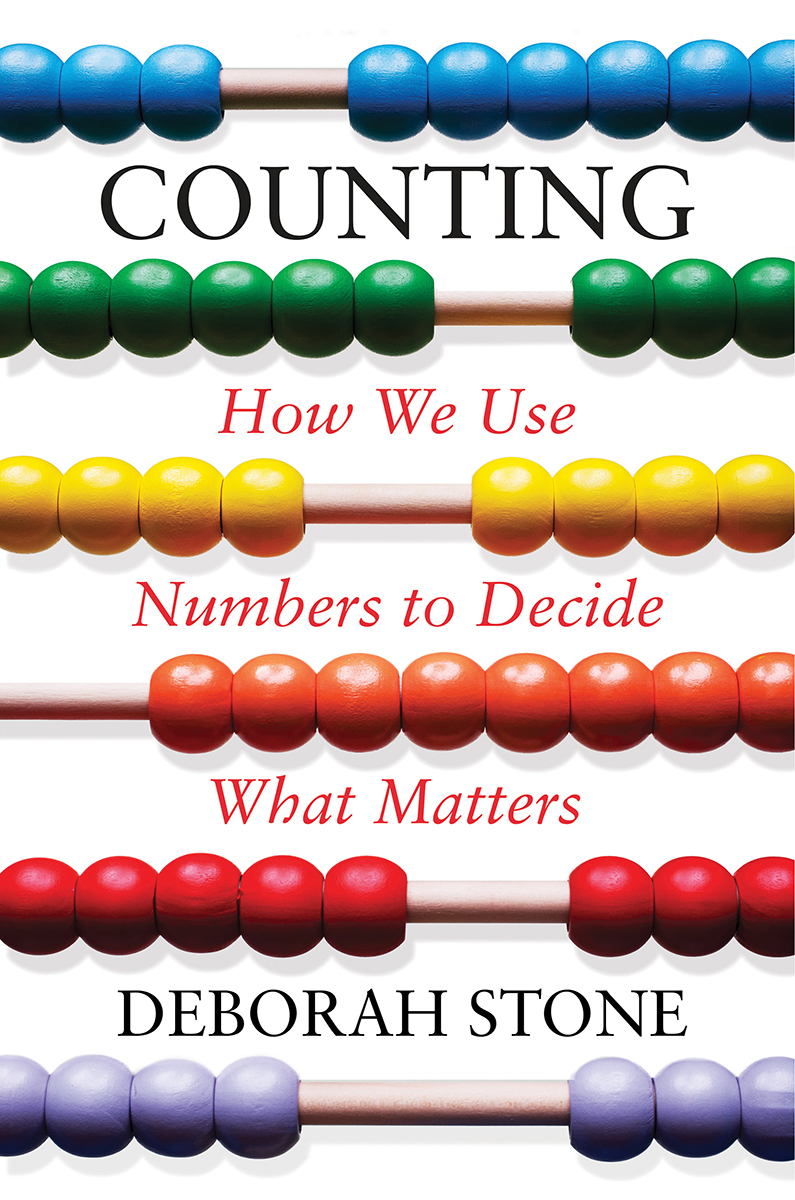
Counting: How We Use Numbers to Decide What Matters
by

21/99
Critics
13/99
Readers
n/a
Scholars
27/99
Rating
15/99
Volume
9/99
Rating
17/99
Volume
—
Sign in to add to your shelf, rate, or review this book.
About This Book
"Deborah Stone's mind-altering insight is that the numbers we use to capture the human experience are themselves a form of creative story-telling. They shouldn't end the conversation, but spark a deeper and richer one. Counting deserves five stars for showing why five stars can never tell the whole story." ―Jacob S. Hacker, co-author of Let Them Eat How the Right Rules in an Age of Extreme Inequality What do people do when they count? What do numbers really mean? We all know that people can lie with statistics, but in this groundbreaking work, eminent political scientist Deborah Stone uncovers a much deeper problem. With help from Dr. Seuss and Cookie Monster, she explains why numbers can't be in order to count, one must first decide what counts. Every number is the ending to a story built on cultural assumptions, social conventions, and personal judgments. And yet, in this age of big data and metric mania, numbers shape almost every facet of our whether we get hired, fired, or promoted; whether we get into college or out of prison; how our opinions are gathered and portrayed to politicians; or how government designs health and safety regulations. In warm and playful prose, Counting explores what happens when we measure nebulous notions like merit, race, poverty, pain, or productivity. When so much rides on numbers, they can become instruments of social welfare, justice, and democracy―or not. The citizens of Flint, Michigan, for instance, used numbers to prove how their household water got contaminated and to force their government to take remedial action. In stark contrast, the Founding Fathers finessed an intractable conflict by counting each slave as three-fifths of a person in the national census. They set a terrible precedent for today's politicians who claim to solve moral and political dilemmas with arithmetic. Suffused with moral reflection and ending with a powerful epilogue on COVID-19's dizzying statistics, Counting will forever change our relationship with numbers.
Preview
Reviews
"A delightful takedown of our unreasonable worship of numbers ..."
"this is a stimulating layperson's guide to the pseudo-mathematical rationalizations behind so much of what governments do."
"I worry that it inadvertently provides some support to people who don't believe that science and logic can be used to tell us anything about reality, who cling to the idea that science is flawed in order to justify their own pet conspiracy theories ..."
Reader Reviews
0 reviewsSign in to write a review.
No reader reviews yet. Be the first!