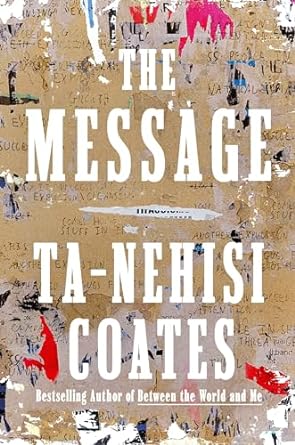
The Message
by


9/99
Critics' Rating Index

97/99
Readers' Rating Index
95/99
Scholars' Citation Index
96/99
Volume of Reviews
98/99
Volume of Reader Ratings
Sign in to add to your shelf, rate, or review this book.
About This Book
Ta-Nehisi Coates originally set off to write a book about writing, in the tradition of Orwell's classic Politics and the English Language, but found himself grappling with deeper questions about how our stories—our reporting and imaginative narratives and mythmaking—expose and distort our realities. The first of the book's three intertwining essays is set in Dakar, Senegal. Despite being raised as a strict Afrocentrist, Coates had never set foot on the African continent until now. He roams the "steampunk" city of "old traditions and new machinery," but everywhere he goes he feels as if he's in two places at once: a modern city in Senegal and a mythic kingdom in his mind. Finally he travels to the slave castles off the coast and has his own reckoning with the legacy of the Afrocentric dream. He takes readers along with him to Columbia, South Carolina, where he meets an educator whose job is threatened for teaching one of Coates's own books. There he discovers a community of mostly white supporters who were transformed by the "racial reckoning" of 2020. But he also explores the backlash to this reckoning and the deeper myths of the community—a capital of the confederacy with statues of segregationists looming over its public squares. And in Palestine, Coates discovers the devastating gap between the narratives we've accepted and the clashing reality of life on the ground. He meets with activists and dissidents, Israelis and Palestinians—the old, who remember their dispossessions on two continents, and the young, who have only known struggle and disillusionment. He travels into Jerusalem, the heart of Zionist mythology, and to the occupied territories, where he sees the reality the myth is meant to hide. It is this hidden story that draws him in and profoundly changes him—and makes the war that would soon come all the more devastating. Written at a dramatic moment in American and global life, this work from one of the country's most important writers is about the urgent need to untangle ourselves from the destructive nationalist myths that shape our world—and our own souls—and embrace the liberating power of even the most difficult truths.
Reviews
"A revelatory meditation on shattering journeys."
"I am not exactly sure what to make of The Message, which, more than anything, is about the moral conversion of a famous writer."
"Coates exhorts readers, including students, parents, educators, and journalists, to challenge conventional narratives that can be used to justify ethnic cleansing or camouflage racist policing."
"To absorb the rest of the essay, to reread and reread it, is to sense that his rendering of his experience inside Yad Vashem is strategic as well as sincere, a means of inoculating himself against charges of insensitivity or worse as he becomes purely polemical and takes up, without any complication, the Palestinian anti-colonial narrative ..."
"There are some stories that are not his to tell."
"Coates always writes with a purpose ..."
"In its guise as an aesthetic effort, it is not entirely successful ..."
"Charts Coates's re-entry as a public intellectual; it also marks a shift in his approach."
"Coates believes that writing can change the world."
"Takes a half step toward task fulfillment."
Preview
Reader Reviews
0 reviewsSign in to write a review.
No reader reviews yet. Be the first!